
Why Purpose Matters More Always
In conversations with professionals, founders, and senior leaders across industries, a consistent pattern emerges. Many work hard, advance quickly, and remain busy, yet struggle to articulate their deeper motivation. This is not about job descriptions, but about the underlying reason that endures when roles change, markets shift, or certainty fades—the power of purpose that gives direction beyond titles.
This became clear in a recent conversation with a senior product lead at a leading global chemical company. He was considering a move from core product development into a strategy role. On paper, it looked like a smart progression. But when I asked a simple question—why this shift, now—he stopped. There was no evident frustration with his current role, no pull toward a specific impact. Just a sense that “it felt like the next step.” It wasn’t a decision rooted in purpose. It was motion, not direction.
That pause is more revealing than it appears. It reflects a broader reality in today’s professional world: many people are progressing without direction. They chase roles, compensation, or prestige, yet carry a quiet sense that something is missing. The issue is rarely a lack of ambition or capability. More often, it is the absence of a clear purpose.
We live in an environment defined by volatility—industries transform, skills expire, and career paths that once looked linear now feel fragmented. In such conditions, growth without purpose becomes fragile. It looks impressive on the surface, but lacks inner coherence. People advance, but feel disconnected from their own trajectory.
Purpose is not a motivational slogan or a line in a corporate handbook. It is the underlying reason we show up, make choices, and persist when outcomes are uncertain. It explains why a particular path matters to us. Vision may describe where we want to go. Goals may define what we aim to achieve. But purpose answers the more fundamental question: why is this journey worth taking at all?
When purpose is clear, growth gains direction. Decisions become easier. Trade-offs feel intentional rather than reactive. When it is missing, even success can feel strangely hollow—busy, but not meaningful.
This is why purpose matters more than ever. In a world full of options and constant motion, it is no longer enough to move forward. We need to know why we are moving, and what makes that movement worth sustaining.
Idea in Brief
The Problem: Many professionals and organizations are growing, but without a clear sense of why. As careers become less linear and business environments more volatile, progress without purpose leads to drift, disengagement, and decisions that feel busy rather than meaningful.
The Insight: Purpose is not a motivational statement or a branding exercise. It is an existential anchor. When clearly defined, it brings coherence to career choices, strengthens resilience, and aligns organizational strategy with human commitment.
The Implication: Individuals with a clear purpose make better long-term decisions and sustain growth through uncertainty. Organizations that embed purpose into leadership, systems, and culture outperform not by chasing meaning—but by building it into how they operate.
Purpose Is Not Vision, Mission, or Goals
One of the most persistent mistakes leaders and professionals make is using purpose, vision, and mission interchangeably. They are related—but they are not the same. Confusing them weakens strategy, clouds decision-making, and ultimately dilutes growth.
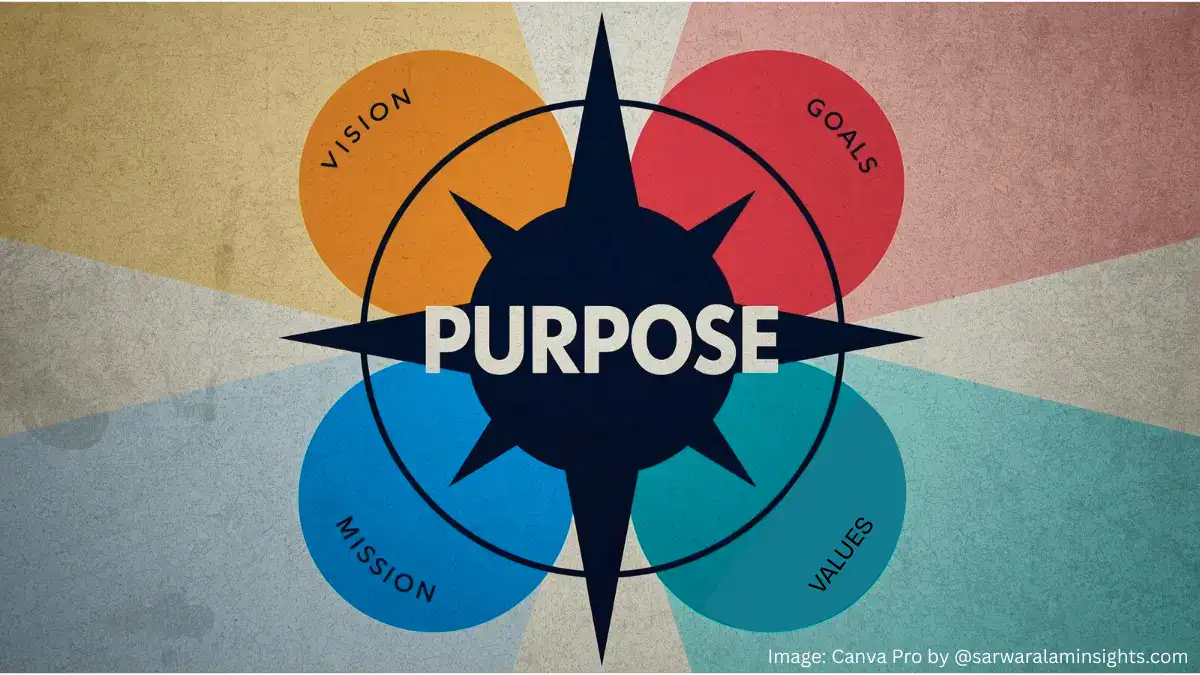
Purpose answers why we exist.
Vision defines where we are going.
Mission explains how we intend to get there.
Goals describe what we aim to achieve along the way.
When these elements are blurred, organizations may appear aligned on paper but remain disconnected in practice. Individuals, too, fall into this trap—setting ambitious goals or chasing attractive titles without anchoring those moves in a more profound sense of purpose.
Purpose sits at the core. It is existential, not tactical. It speaks to meaning, contribution, and intent. Vision, by contrast, is directional. It points to a future state. A mission translates that direction into action. Goals then operationalize progress. Without purpose at the center, the entire structure becomes fragile.
This distinction matters because vision without purpose feels hollow. It may inspire in the short term, but it struggles to sustain commitment when conditions become difficult. People might know where they are heading, yet remain unsure why that destination matters enough to endure uncertainty, sacrifice, or change.
Purpose prevents drift. When it is clear—and lived rather than merely stated—it creates coherence between leadership intent and everyday work. Decisions made at the top begin to resonate with actions on the ground. Strategy gains emotional weight. Routine tasks feel connected to something larger.
When purpose is absent or reduced to a slogan, the opposite happens. Strategy loses its soul. Individuals and teams stay active but disconnected, productive but unfulfilled. Over time, effort turns mechanical, and growth becomes performative rather than meaningful.
Understanding the distinct role of purpose is not semantic precision—it is a leadership necessity. Vision tells us where we are going. Mission outlines the path. Purpose reminds us why the journey is worth taking at all.
The Hidden Cost of a Missing Purpose
The absence of purpose rarely looks dramatic. It shows up quietly—in careers that keep moving but feel strangely hollow, and in organizations that perform well on paper yet struggle to sustain energy, trust, or coherence. People remain active, even successful, but something essential is missing.
For individuals, this gap often appears as constant recalibration. Frequent role changes. Endless upskilling without direction. Decisions driven by external signals rather than internal conviction. Over time, this creates decision fatigue. When every option looks equally valid, clarity disappears. Progress becomes reactive instead of intentional.
There is also a psychological cost. Without a clear why, setbacks feel heavier and transitions more destabilizing. Failure is interpreted as personal loss rather than part of a meaningful trajectory. Even high performers begin to overthink—not because they lack confidence, but because they lack an anchor.
Organizations face a parallel problem. When the purpose is unclear or purely symbolic, priorities fragment. Teams execute tasks efficiently but struggle to see how their work connects to a larger whole. Engagement declines quietly. Retention becomes transactional. Strategy turns short-term, driven more by quarterly pressure than long-term relevance.
What makes this especially dangerous is that motion masks the problem. Activity creates the illusion of progress. Metrics keep moving. Yet beneath the surface, coherence erodes. Effort is no longer cumulative. Each win stands alone, adding to hidden decision debt rather than long-term momentum.
Purpose does not eliminate uncertainty. It gives an uncertainty context. Without it, growth becomes a series of disconnected moves—impressive in isolation, but weak in meaning and durability.
This is why purpose is not a “soft” concern. It is a structural one. When it is missing, both individuals and institutions pay for it slowly, and often too late to trace the cause clearly.
How Purpose Drives Individual Growth
Careers today are no longer linear. Roles evolve, industries blur, and definitions of success keep shifting. In such an environment, technical competence alone is not enough to sustain growth. What differentiates those who progress with clarity from those who merely stay busy is a well-defined sense of purpose.
Purpose acts as a decision filter. When it is clear, professionals stop chasing every attractive opportunity and instead choose roles, projects, and organizations that align with their values and long-term goals. This does not slow growth; it sharpens it. Energy is spent deliberately, not scattered across competing priorities—often by choosing the right place to grow rather than the loudest option.
It also strengthens resilience. Setbacks, transitions, and periods of uncertainty are inevitable. Individuals anchored in purpose interpret these moments differently. They see disruption as part of a larger arc rather than a verdict on their ability. As a result, they recover faster and stay engaged longer.
Significantly, purpose reframes how impact is measured. Advancement is no longer defined only by promotion or compensation, but by the quality of contribution and the consistency between work and values. This shift reduces the quiet dissatisfaction that often accompanies outward success and helps build careers thoughtfully rather than opportunistically.
Consider a mid-career professional who chooses a role with moderate visibility but high relevance to a long-standing interest—such as improving access, safety, or sustainability—over a faster but misaligned track. The immediate rewards may appear smaller. Over time, however, this alignment compounds into more profound expertise, stronger motivation, and a cohesive career narrative.
Purpose does not replace skill, effort, or ambition. It gives them direction. Without it, growth remains possible—but rarely coherent or enduring.
Purpose, Skills, and the Modern Professional
Purpose alone does not create growth. Without capability, it remains aspirational. Without character, it becomes fragile. Sustainable progress emerges when purpose, skills, and judgment reinforce one another.
In the modern professional landscape, technical skills age quickly. What compounds over time are human capabilities—clear thinking, communication, adaptability, and sound judgment. Purpose gives these skills direction. It helps professionals decide which skills to build, when to pivot, and what to ignore—especially the soft skills that endure across roles and industries.
This is where many capable people stall. They invest heavily in acquiring competencies, yet feel stuck. The issue is not effort. It is misalignment. Skills are accumulated without a clear sense of how they apply or contribute. Learning becomes defensive rather than strategic.
Purpose also counteracts overthinking. When direction is unclear, every decision feels high-stakes. Professionals hesitate, waiting for perfect information or reassurance. A clear purpose reduces this paralysis. It does not guarantee correct choices, but it enables timely ones. Action becomes aligned rather than anxious.
Equally important is character—the willingness to make trade-offs, accept discomfort, and stay consistent under pressure. Purpose strengthens this internal discipline. It clarifies what is worth declining, even when the alternative appears attractive.
In practice, the most effective professionals are not those with the longest skill lists. They are those who have aligned capability with intent. Purpose ensures that learning, effort, and experience accumulate in the same direction.
Without that alignment, growth may continue—but it rarely compounds.
How Purpose Shapes Organizations for Long-Term Success
Organizations do not struggle because they lack strategy. Most struggle because their strategy is unanchored. When purpose is unclear, decisions become reactive, priorities compete, and short-term performance quietly overrides long-term relevance.
Purpose functions as an internal stabilizer. It aligns leadership intent with operational reality. When people understand why the organization exists—not just what it sells or targets—they make better decisions without waiting for instruction. Judgment improves. Coordination strengthens across leadership systems that shape everyday behavior.
This is also where purpose becomes a competitive advantage. Products, services, and even business models can be replicated. An authentic purpose cannot. It connects culture with brand, employee behavior with customer experience. Over time, this coherence builds trust—internally and externally—especially in organizations that prioritize culture over performance theatrics.
Organizations with a clear purpose redefine success. Financial outcomes still matter, but they are treated as results of value creation, not the sole objective. This shift influences how trade-offs are made: whom to hire, which opportunities to decline, and where to invest patience rather than speed.
Leadership plays a decisive role here. Purpose cannot live in presentations or annual reports. It must show up in incentives, performance reviews, and resource allocation. When leaders reward behavior that contradicts stated purpose, credibility erodes quickly.
Consider how Satya Nadella framed Microsoft’s purpose around empowerment rather than dominance. That shift was not rhetorical. It reshaped culture, collaboration, and innovation priorities—contributing to renewed relevance and sustained growth.
Purpose does not eliminate complexity. It reduces confusion. In doing so, it allows organizations to grow not just faster—but more coherently, and for longer.
Leadership’s Role in Making Purpose Real
Purpose succeeds or fails at the leadership level. Not because leaders define it—but because they signal what truly matters through everyday decisions. People do not follow purpose statements. They follow what gets rewarded, promoted, and protected.
When leadership treats purpose as communication rather than discipline, it collapses under pressure. Teams quickly learn the fundamental rules: short-term results matter more than stated values, speed more than substance, and appearance more than intent. Once that gap becomes visible, purpose loses credibility.
Effective leaders translate purpose into systems. Hiring criteria reflect it. Performance metrics reinforce it. Trade-offs are evaluated against it. This consistency reduces ambiguity. It allows people to act with confidence, even in situations not covered by policy, primarily shaped by the leadership systems that leaders reinforce daily.
Purpose also becomes most visible during tension—when revenue conflicts with values, when growth challenges culture, or when cost pressures test commitments. In such moments, leadership behavior either strengthens trust or erodes it permanently. Purpose is proven not in stability, but in strain.
This is why leadership alignment matters more than leadership messaging. A single decision that contradicts purpose can undo years of carefully worded intent. Conversely, one well-judged, purpose-aligned choice can reset expectations across the organization.
Purpose, in practice, is a leadership operating system. When leaders embody it consistently, organizations gain clarity, speed, and moral authority. When they don’t, purpose becomes decorative—and eventually irrelevant.
Purpose Lived, Not Claimed: A Real-World Illustration
Purpose becomes credible only when it guides difficult decisions. A clear example comes from Indra Nooyi during her tenure at PepsiCo. Her articulation of Performance with Purpose was not intended to be a speech. It was meant to discipline choices.
The idea challenged prevailing assumptions. PepsiCo would pursue financial performance, but not at the expense of the long-term health of consumers, employees, or the business itself. This meant investing in healthier product lines, rethinking supply chains, and integrating sustainability into the core strategy. None of these moves delivered instant applause. Some faced internal resistance. Several carried short-term costs.
What mattered was consistency. Capital allocation, leadership priorities, and public commitments moved in the same direction. Purpose was not layered on top of strategy; it shaped it—an example of moving beyond performance culture thinking toward durable value creation. Over time, this alignment strengthened trust with stakeholders and positioned the company for durability in a changing market.
The lesson is not to copy the language. It is to observe the mechanism. Purpose worked because it was operationalized—embedded in decisions where trade-offs were real. Many organizations fail here. They declare intent but hesitate when it becomes inconvenient.
Purpose does not require moral grandstanding. It requires discipline. When leaders allow purpose to govern choices under pressure, it stops being abstract and starts becoming strategic.
This distinction—between stated values and enforced values—is where most purpose efforts either mature or quietly fail.
Defining Purpose: A Practical Framework
Purpose is often discussed in abstract terms, which makes it easy to admire and difficult to use. In practice, clarity does not come from grand statements. It comes from disciplined questioning. Whether for individuals or organizations, purpose emerges where intent, impact, and values intersect.
A useful purpose is not inspirational language. It is a working reference for decisions—especially when choices are unclear, or trade-offs are uncomfortable. This is where curiosity becomes instrumental—not as exploration for its own sake, but as structured inquiry.
For individuals, purpose becomes clearer by confronting three fundamental questions:
• What consistently holds my attention beyond rewards—what sustains my interest even when progress is slow, and recognition is absent?
• What kind of impact do I want my work to create—thinking in terms of contribution rather than role, and asking who or what should be better because of my effort?
• Which values are non-negotiable under pressure—the principles I am unwilling to trade even when doing so would be convenient or rewarding?
When answered honestly, these questions reduce noise. They do not eliminate options, but they make misaligned ones easier to decline. Over time, they bring coherence to decisions that might otherwise feel fragmented.
For organizations, the same discipline applies at a broader scale. Purpose must function as decision logic, not as messaging—requiring strategic thinking rather than slogans:
• What core problem do we exist to solve beyond revenue?
• What change should our presence create in our industry or in society?
• What legacy should remain if this organization truly succeeds?
Purpose becomes actionable only when leaders are willing to test real decisions against these questions—especially when outcomes are uncertain, unpopular, or costly in the short term.
A clear purpose is not meant to provide constant certainty. It is intended to offer orientation when certainty is absent. When used this way, purpose stops being philosophical and becomes practical.
Purpose as a Living System
Purpose is not a one-time declaration. It is a system that must remain visible, tested, and adjusted as contexts change. When treated as static, it slowly loses relevance. When treated as living, it continues to guide judgment.
For individuals:
Periodic reflection is essential. Careers evolve. Responsibilities expand. What once felt aligned may no longer fit. Purpose does not require reinvention every year, but it does require honest check-ins. Are current choices reinforcing the original intent—or quietly drifting away from it? This kind of consistency is sustained through daily habits, not occasional insight.
For organizations:
The greater risk is complacency. Markets shift, leadership changes, and strategies adapt. Purpose must be revisited—not to dilute it, but to ensure it still governs decisions. Annual reviews, leadership off-sites, and strategic planning cycles are natural moments to stress-test relevance.
Continuity over rigidity:
Purpose should remain stable enough to anchor identity, yet flexible enough to stay meaningful. When leaders avoid revisiting it out of fear of inconsistency, purpose becomes symbolic. When they revisit it thoughtfully, it becomes resilient.
A living purpose creates continuity across change. It allows both people and institutions to evolve without losing their core. In uncertain environments, this continuity is not a luxury. It is a competitive and psychological advantage.
Embedding Purpose into Daily Action
Purpose only matters when it shapes behavior. The test is simple: does it influence real decisions when trade-offs appear?
1. Use Purpose as a Daily Decision Filter
For individuals, purpose should guide everyday choices—not just major career moves.
- Before accepting a role, project, or commitment, ask: Does this move reinforce my long-term intent?
- Declining misaligned opportunities is as important as pursuing aligned ones.
- Consistency in small decisions determines whether purpose compounds or erodes.
2. Translate Purpose into Organizational Systems
For organizations, purpose must be embedded where behavior is shaped.
- Hiring: Who is selected and why
- Performance: What is measured and rewarded
- Resources: Where time, capital, and attention are allocated
If purpose does not influence these systems, it remains symbolic.
3. Reinforce Purpose Through Leadership Behavior
Purpose becomes real through what leaders do under pressure.
- Teams observe trade-offs more than messages.
- When short-term convenience overrides stated intent, credibility declines.
- When decisions consistently favor long-term purpose, trust strengthens.
4. Reference Purpose Selectively—Not Constantly
Overuse weakens authority.
- Purpose should surface at moments of tension, ambiguity, or consequence.
- Restraint signals seriousness.
- Selective invocation makes purpose a guide for judgment, not background noise.
5. Aim for Consistency, Not Perfection
Embedding purpose is not about ideal outcomes.
- Missteps will occur.
- What matters is correction, not denial.
- Repeated alignment builds reliability over time.
Purpose embedded this way stops being aspirational. It becomes dependable.
Conclusion: Growth Without Purpose Is Just Motion
Growth, by itself, is not progress. Without purpose, it is movement without direction—active, measurable, and ultimately fragile.
Purpose gives growth coherence. It aligns decisions across time. It connects effort to meaning. For individuals, it transforms careers from a sequence of roles into a sustained trajectory. For organizations, it turns strategy into something people can commit to—not just execute. This distinction between momentum and meaning is increasingly recognized in serious work on organizational purpose.
Purpose is not a statement to be written once and admired. It is a system to be lived, tested, and reinforced through choice. When treated this way, it becomes a quiet multiplier—shaping judgment, strengthening resilience, and sustaining relevance.
In an environment defined by constant change, clarity of purpose is no longer optional. It is the foundation that enables growth to last, leadership to matter, and success to mean more than momentum.